Skin Care
Learn how tranexamic serum may support pigmentation care, dark spots, post-acne marks and uneven skin tone, and how to add it to your routine.

Tranexamic Serum: Benefits, Uses & Pigmentation Guide
If you are dealing with dark spots, post-acne marks, uneven skin tone, or pigmentation, a tranexamic serum may be a useful addition to your skincare routine. Tranexamic acid is an ingredient increasingly used in skincare formulations designed to improve the appearance of discoloration.
Unlike exfoliating acids that primarily work by removing dead skin cells, tranexamic acid is used to help regulate pathways involved in pigmentation. It can be especially relevant for people concerned about uneven tone and melasma, although results depend on the cause and severity of pigmentation.
What Is Tranexamic Serum?
A TXA serum is a topical skincare product containing tranexamic acid, commonly abbreviated as TXA. Tranexamic acid was originally developed as a medicine that helps control bleeding, but topical formulations have also been studied for pigmentation concerns.
A tranexamic face serum is generally designed to target the appearance of dark spots, uneven skin tone, and other forms of hyperpigmentation.
The exact concentration and formulation vary between products, so the ingredient list and directions should always be checked before use.
How Does Tranexamic Acid Help With Pigmentation?
Pigmentation is influenced by several biological processes, including signals that stimulate melanin production. Tranexamic acid may help interfere with some of these pathways, which is why it has been investigated as a topical option for hyperpigmentation and melasma.

However, pigmentation has many possible causes. Post-inflammatory hyperpigmentation after acne, sun-related pigmentation, and melasma do not necessarily respond in exactly the same way.
For this reason, a discoloration correcting serum should be considered part of an overall pigmentation routine rather than a standalone solution.
Benefits of Tranexamic Serum
A well-formulated tranexamic serum may be useful for several pigmentation-related concerns.
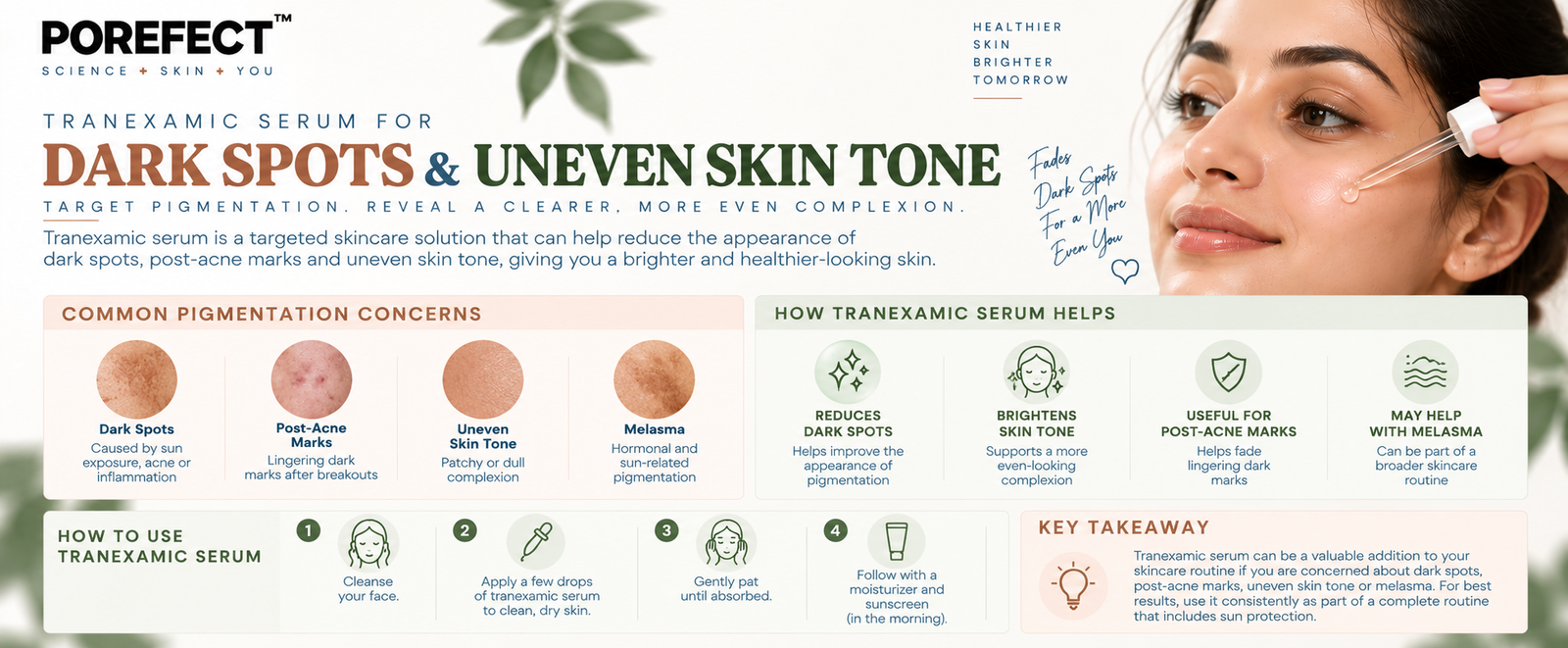
Helps Improve the Appearance of Dark Spots
Tranexamic acid is commonly included in formulations designed to reduce the appearance of uneven pigmentation and dark marks.
Supports More Even-Looking Skin Tone
Regular use may help improve the appearance of uneven tone when pigmentation is the main concern.
Useful for Post-Acne Marks
People who develop lingering dark marks after acne may consider tranexamic acid as one option alongside other pigmentation-focused ingredients.
May Be Used for Melasma
Topical tranexamic acid has been studied for melasma. Because melasma can be chronic and recurrent, treatment usually involves consistent sun protection and a broader management strategy rather than relying on one serum.
Tranexamic Serum vs Other Brightening Ingredients
Tranexamic acid is not the only ingredient used for pigmentation. Depending on your skin and concern, it may be combined with or alternated with other ingredients.

Tranexamic and Niacinamide
A tranexamic and niacinamide serum can combine two ingredients commonly used in pigmentation-focused skincare.
Niacinamide can support the skin barrier and may help improve the appearance of uneven tone, while tranexamic acid is specifically used in formulations targeting discoloration.
This combination may be convenient for people who want a simplified routine, provided their skin tolerates the formula.
Tranexamic Acid and Arbutin
A tranexamic and arbutin advanced brightening serum combines tranexamic acid with alpha-arbutin, another ingredient used in products targeting uneven pigmentation.
Combining several brightening ingredients does not automatically mean faster results. Formula quality, consistency, skin tolerance, and sunscreen use remain important.
Tranexamic Acid, Kojic Acid and Niacinamide
A tranexamic acid kojic acid and niacinamide serum may contain several pigment-targeting ingredients in one formula.
Kojic acid is commonly used in brightening products, while niacinamide supports the skin barrier and tranexamic acid targets pigmentation pathways. Because multiple active ingredients can sometimes increase irritation, introduce such products gradually.
Tranexamic C Serum
A tranexamic C serum generally refers to a formulation combining tranexamic acid with vitamin C.
Vitamin C provides antioxidant activity and can complement a pigmentation-focused routine. However, the stability and formulation of vitamin C matter, so a product should be evaluated as a complete formulation rather than by ingredient names alone.
What Is Cetyl Tranexamate Mesylate?
Cetyl tranexamate mesylate is a tranexamic-acid-related cosmetic ingredient used in some skincare formulations.
It should not automatically be treated as identical to standard tranexamic acid simply because both names contain “tranexam.” Different forms of an ingredient can have different properties, formulations, and supporting evidence.
When choosing a product, check the complete ingredient list and follow the manufacturer's instructions rather than assuming two products will perform identically.
How to Use Tranexamic Face Serum
A simple routine can help reduce unnecessary irritation when using a tranexamic face serum.
Morning
- Gentle cleanser
- Tranexamic face serum
- Moisturizer
- Broad-spectrum sunscreen
Evening
- Gentle cleanser
- Tranexamic serum
- Moisturizer
If your serum contains multiple active ingredients, follow its specific directions.
Sunscreen is particularly important when treating pigmentation. Daily UV exposure can contribute to persistent or recurring discoloration, making consistent sun protection an essential part of pigmentation care.
Can Tranexamic Serum Be Used With Other Actives?
Tranexamic acid can often be incorporated into a routine containing other skincare ingredients, but using multiple active products at once is not always necessary.
If you already use vitamin C, niacinamide, retinoids, exfoliating acids, or other pigmentation treatments, introduce changes gradually.
Using several strong products simultaneously can increase dryness and irritation, which may be especially problematic for people prone to post-inflammatory pigmentation.
A simple routine that you can use consistently is often more practical than an unnecessarily complicated one.
Minimalist Tranexamic Serum: What Should You Check?
People searching for Minimalist tranexamic serum are usually comparing a specific branded formulation with other tranexamic-acid products.
Rather than judging a serum solely by its brand name, check:
- Tranexamic acid concentration
- Other active ingredients
- Full ingredient list
- Product texture and suitability for your skin type
- Packaging and storage instructions
- Whether your skin tolerates the formula
A product containing tranexamic acid is not automatically suitable for every type of pigmentation.
Who Should Be Careful With Tranexamic Serum?
Most skincare users can introduce a properly formulated serum gradually, but irritation is possible.
Stop or reduce use if you develop significant burning, persistent redness, swelling, or worsening irritation.
If pigmentation is rapidly changing, spreading unexpectedly, associated with other skin changes, or does not improve despite consistent skincare, professional assessment may be appropriate. Melasma and persistent hyperpigmentation can require a more individualized treatment plan.
Frequently Asked Questions
Is Tranexamic Serum Good for Pigmentation?
Tranexamic acid is used in topical skincare products designed to improve the appearance of hyperpigmentation and uneven skin tone. Its suitability depends on the cause of pigmentation and the overall formulation.
Can I Use Tranexamic Serum Every Day?
Many formulations are designed for regular use, but follow the specific product instructions. If you are new to the ingredient, gradual introduction can help assess tolerance.
Can Tranexamic Serum Remove Dark Spots Permanently?
No skincare serum can guarantee permanent removal of dark spots. Pigmentation can return, particularly when the underlying trigger continues or sun protection is inconsistent.
Can I Use Tranexamic Acid With Niacinamide?
Tranexamic acid and niacinamide can be used together in suitable formulations. Both are commonly found in pigmentation-focused skincare products.
Is Tranexamic Serum Suitable for Melasma?
Topical tranexamic acid has been studied for melasma, but melasma is a chronic condition that can recur. Sunscreen and an individualized treatment plan are important.
Conclusion
A tranexamic serum can be a useful option for people looking to improve the appearance of pigmentation, dark spots, post-acne marks, and uneven skin tone. Tranexamic acid can also be formulated with ingredients such as niacinamide, arbutin, kojic acid, and vitamin C.
The best approach is to choose a formulation that suits your skin, introduce active ingredients gradually, and use sunscreen consistently. If pigmentation is persistent, severe, recurrent, or difficult to identify, professional evaluation can help determine the underlying cause and appropriate treatment.