Skin Care
Discover the best products for hyperpigmentation, key skincare ingredients, sunscreen tips, and a simple routine for dark spots and uneven skin tone.
Best Products for Hyperpigmentation: Ingredients, Treatments & Skincare Routine
Dark spots, post-acne marks, tanning, and uneven skin tone are common concerns, but the right approach is not the same for everyone. The best products for hyperpigmentation depend on the cause of pigmentation, your skin type, the active ingredients used, and how well your skin tolerates the formulation.
Hyperpigmentation can develop after acne and inflammation, with repeated sun exposure, or as part of conditions such as melasma. A practical routine combines a suitable pigmentation-focused active with consistent sun protection and a healthy skin barrier.
What to Look for in Hyperpigmentation Products
When comparing the best products for hyperpigmentation, focus on the active ingredient, formulation, skin compatibility, and tolerability rather than claims such as “brightening,” “spot removal,” or “instant results.”
When choosing a pigmentation product, focus on the active ingredient, formulation, skin compatibility, and tolerability rather than claims such as “brightening,” “spot removal,” or “instant results.”
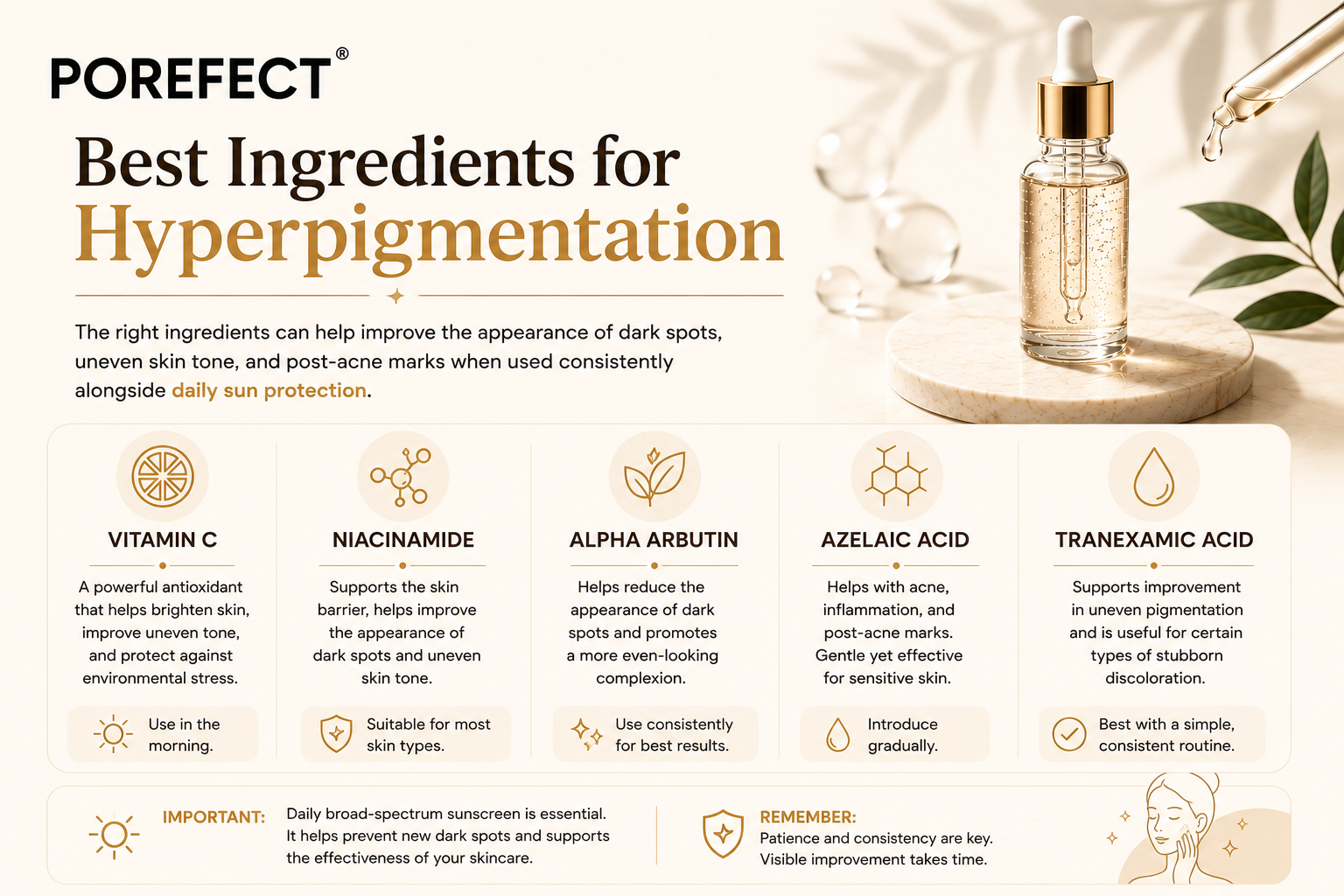
Vitamin C
Vitamin C is an antioxidant commonly used for dullness and uneven skin tone. It may support a more even-looking complexion and is often used in the morning. Its performance depends on the formulation, stability, concentration, and skin tolerance.
Niacinamide
Niacinamide, a form of vitamin B3, supports the skin barrier and can help improve the appearance of uneven pigmentation. It can be a useful option for oily or blemish-prone skin and is generally easy to incorporate into a routine.
Alpha Arbutin
Alpha arbutin is frequently used in pigmentation-focused skincare to help improve the appearance of dark spots. It may be considered when uneven tone is the main concern, provided the formulation is well tolerated.
Azelaic Acid
Azelaic acid can be particularly useful when pigmentation occurs alongside acne or inflammation. Its anti-inflammatory properties make it relevant to acne-prone skin and post-inflammatory pigmentation. Dryness or irritation can occur when starting treatment.
Tranexamic Acid
Topical tranexamic acid is used in some pigmentation-focused products and may be helpful for certain patterns of uneven pigmentation. It is not a universal solution, so persistent or recurring pigmentation should be assessed in context.
Retinoids
Retinoids support skin-cell turnover and are used for acne, uneven texture, and some pigmentation concerns. They can cause dryness and irritation, so they should be introduced gradually. Retinoids are generally avoided during pregnancy unless specifically advised by a healthcare professional.
Which Product Approach Is Best for Your Concern?
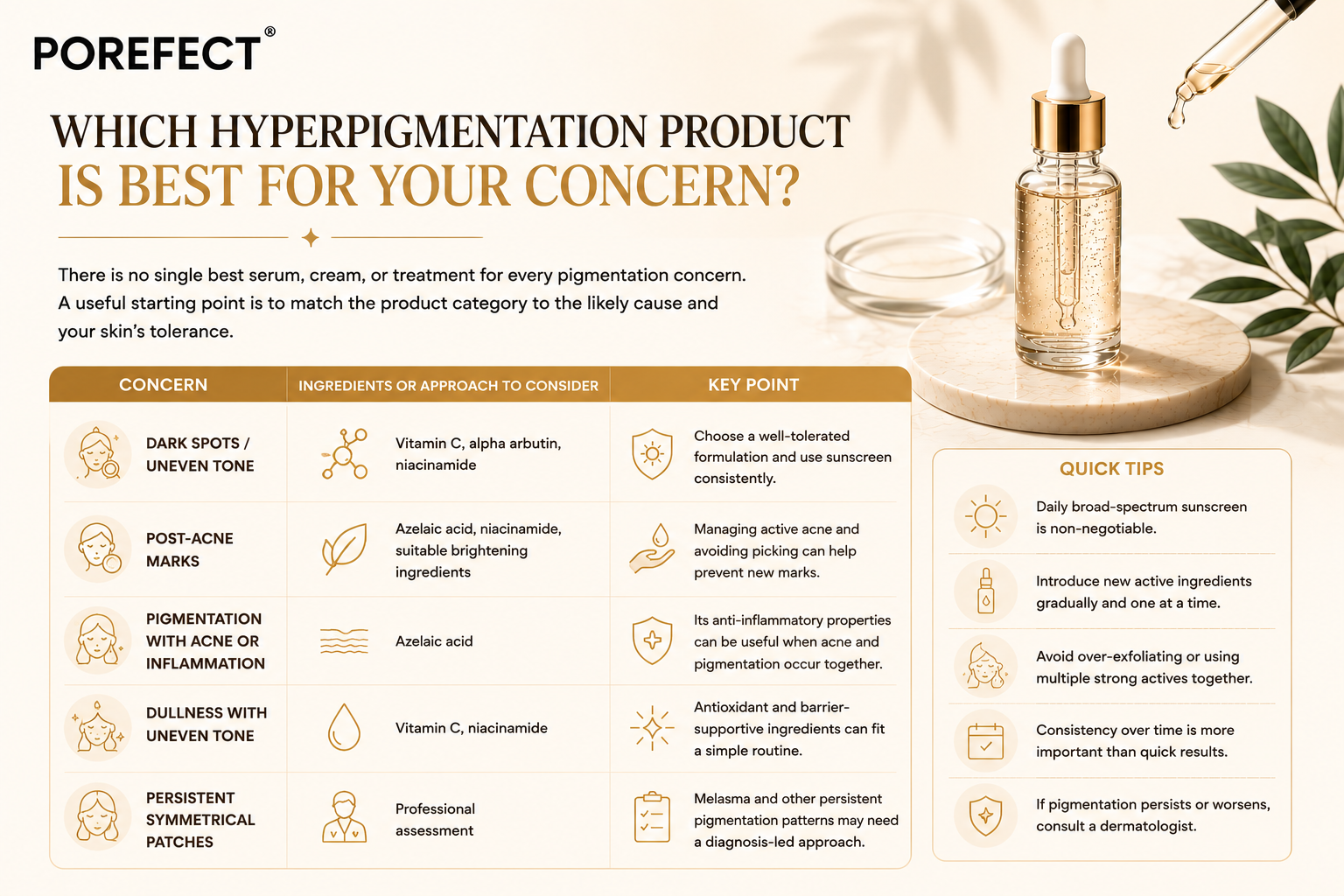
There is no single product that is best for every type of pigmentation. A useful starting point is to match the product category to the likely cause of the pigmentation and your skin’s tolerance.
| Concern | Ingredients or Approach | Key Point |
|---|---|---|
| Dark spots / uneven tone | Vitamin C, alpha arbutin, niacinamide | Choose a well-tolerated formulation and use sunscreen consistently. |
| Post-acne marks | Azelaic acid, niacinamide, suitable brightening ingredients | Managing active acne and avoiding picking can help prevent new marks. |
| Pigmentation with acne or inflammation | Azelaic acid | Useful when acne and pigmentation occur together. |
| Dullness with uneven tone | Vitamin C, niacinamide | Antioxidant and barrier-supportive ingredients can fit a simple routine. |
| Persistent symmetrical patches | Professional assessment | Melasma and other persistent patterns may need a diagnosis-led approach. |
Match the Product to the Type of Pigmentation
Choosing among the best products for hyperpigmentation starts with identifying why the pigmentation developed. The right approach can differ for post-acne marks, sun-related pigmentation, and melasma.
Post-Acne Pigmentation
Dark marks left after acne are often related to post-inflammatory hyperpigmentation. Managing active acne, avoiding picking, and using a suitable routine can help reduce the chance of new marks.
Sun-Related Pigmentation
Frequent UV exposure can increase melanin production and make existing dark spots more noticeable. Daily sunscreen is particularly important when pigmentation is linked to sun exposure.
Melasma
Melasma often appears as persistent, symmetrical patches, commonly on the cheeks, forehead, or upper lip. Sun exposure can worsen it, and hormonal factors may contribute. Because melasma can recur, professional assessment may be more useful than repeatedly changing cosmetic products.
Sunscreen Is Essential for Hyperpigmentation
Sunscreen is one of the most important parts of a pigmentation-focused routine. UV exposure can stimulate melanin production and darken existing pigmentation.
Use a broad-spectrum sunscreen every morning and reapply according to your exposure and the product directions. Consistent sun protection should be treated as part of pigmentation care, not an optional extra.
How to Choose a Hyperpigmentation Product
These factors can help you narrow down the best products for hyperpigmentation for your own routine:
- Your pigmentation concern: Acne marks, sun-related spots, and melasma may need different approaches.
- Your skin type: Lightweight, non-comedogenic formulas may suit oily or acne-prone skin, while dry or sensitive skin may need simpler, barrier-supportive products.
- Ingredient selection: Start with one active ingredient that matches your concern rather than combining several strong actives at once.
- Formulation and tolerability: A product is only useful if you can use it consistently without significant irritation.
- Routine compatibility: Consider how the product fits with your cleanser, moisturizer, sunscreen, and other active ingredients.
What Makes a Good Hyperpigmentation Product?
A good pigmentation-focused product is not necessarily the strongest product. Look for a well-formulated active ingredient that matches your concern, is appropriate for your skin type, and can be used consistently.
Avoid choosing products solely because they contain many active ingredients or promise rapid results. If your skin is sensitive or already irritated, simplifying the routine may be more useful than adding more brightening ingredients. Introducing one targeted active at a time also makes it easier to identify irritation.
What About Pigmentation Removal Creams?
People often search for a pigmentation removal cream, the best cream for hyperpigmentation, or the best cream for pigmentation on the face. However, there is no universal cream that permanently removes every type of pigmentation.
Instead, look for a well-formulated product with an ingredient appropriate for your concern and skin tolerance. Formulation, consistency of use, sun protection, and the underlying cause all matter more than choosing the strongest cream available.
Avoid products that promise overnight clearing, permanent removal, or guaranteed results.
A Simple AM/PM Routine
A simple routine can make the best products for hyperpigmentation easier to use consistently without overwhelming the skin with too many active ingredients.
Morning
- Gentle cleanser
- Suitable brightening ingredient, such as vitamin C or niacinamide
- Moisturizer
- Broad-spectrum sunscreen
Night
- Gentle cleanser
- One targeted pigmentation treatment
- Moisturizer
Do not introduce several strong actives at the same time. If your skin becomes persistently irritated, burning, or excessively dry, reduce active products and focus on supporting the skin barrier.
Common Mistakes to Avoid
- Skipping sunscreen
- Over-exfoliating
- Combining multiple strong actives at once
- Picking or squeezing acne
- Aggressively scrubbing pigmented areas
- Using lemon juice, baking soda, toothpaste, or other harsh DIY remedies
Irritation can make pigmentation more difficult to manage. Also, do not judge a routine by overnight changes; pigmentation generally requires consistent care over time.
When Is Professional Treatment Appropriate?
Some pigmentation concerns need more than cosmetic skincare. A dermatologist can assess the pattern and possible cause before recommending treatment. Depending on the diagnosis, professional care may include prescription treatments, chemical peels, or selected laser-based procedures.
These options are not suitable for everyone. Skin type, sensitivity, pigmentation pattern, and the risk of post-treatment pigmentation should be considered.
Seek professional advice if pigmentation is sudden, rapidly changing, spreading, worsening, unexplained, or not improving despite consistent skincare.
Frequently Asked Questions
Below are common questions people ask when choosing the best products for hyperpigmentation.
What are the best products for hyperpigmentation?
The best products depend on the type of pigmentation, skin type, and individual tolerance. Vitamin C, niacinamide, alpha arbutin, azelaic acid, or tranexamic acid may be useful depending on the concern. Daily sunscreen is essential.
What is the best serum for hyperpigmentation?
There is no single best serum for everyone. The appropriate serum depends on the type of pigmentation, skin type, formulation, and tolerance.
What is the best hyperpigmentation treatment for the face?
There is no single best treatment. The appropriate option depends on the cause, skin type, pigmentation pattern, and individual tolerance.
Is there a best cream for hyperpigmentation?
There is no universal best cream. Choose a well-formulated product with an ingredient suited to your concern and one that your skin can tolerate consistently.
How long does pigmentation treatment take to work?
The timeline varies with the cause and treatment. Consistent skincare and sun protection are more realistic than expecting immediate results.
When should I see a dermatologist?
Seek professional assessment for sudden, changing, spreading, unexplained, persistent, or difficult-to-manage pigmentation.
Final Thoughts
Choosing the best products for hyperpigmentation does not mean selecting the strongest product or the one with the longest ingredient list. Good pigmentation care starts by understanding the cause, choosing suitable ingredients, protecting the skin from UV exposure, and maintaining a healthy skin barrier.
Whether you need a pigmentation treatment, broader skincare for uneven tone, or guidance on pigmentation on the face, choose a routine that fits your skin and that you can follow consistently. If pigmentation is persistent or difficult to identify, a dermatologist can help determine the appropriate next step.